Dun Gerashader. (NG 4892 4527) Visited
29th November 2016
People driving from Portree to Staffin will pass Dun
Gerashader without a second thought – just another pile of stones. Easily accessed - drive approximately one
mile from Portree on the Staffin road, park at the large layby on the right immediately
before the Torvaig Road. Enter the field
via the gate just along the Torvaig road.
(Please enusre you close the gate carefully as there are cows grazing here; placidly grazing, these did not appear to be the fairy cows mentioned later) ) The short route to the Dun is boggy, trampled by cows and waterproof footwear is needed as there are a few narrow burns to cross.
The Dun area is best accessed from the South (head left as you enter the field).
The Dun area is best accessed from the South (head left as you enter the field).
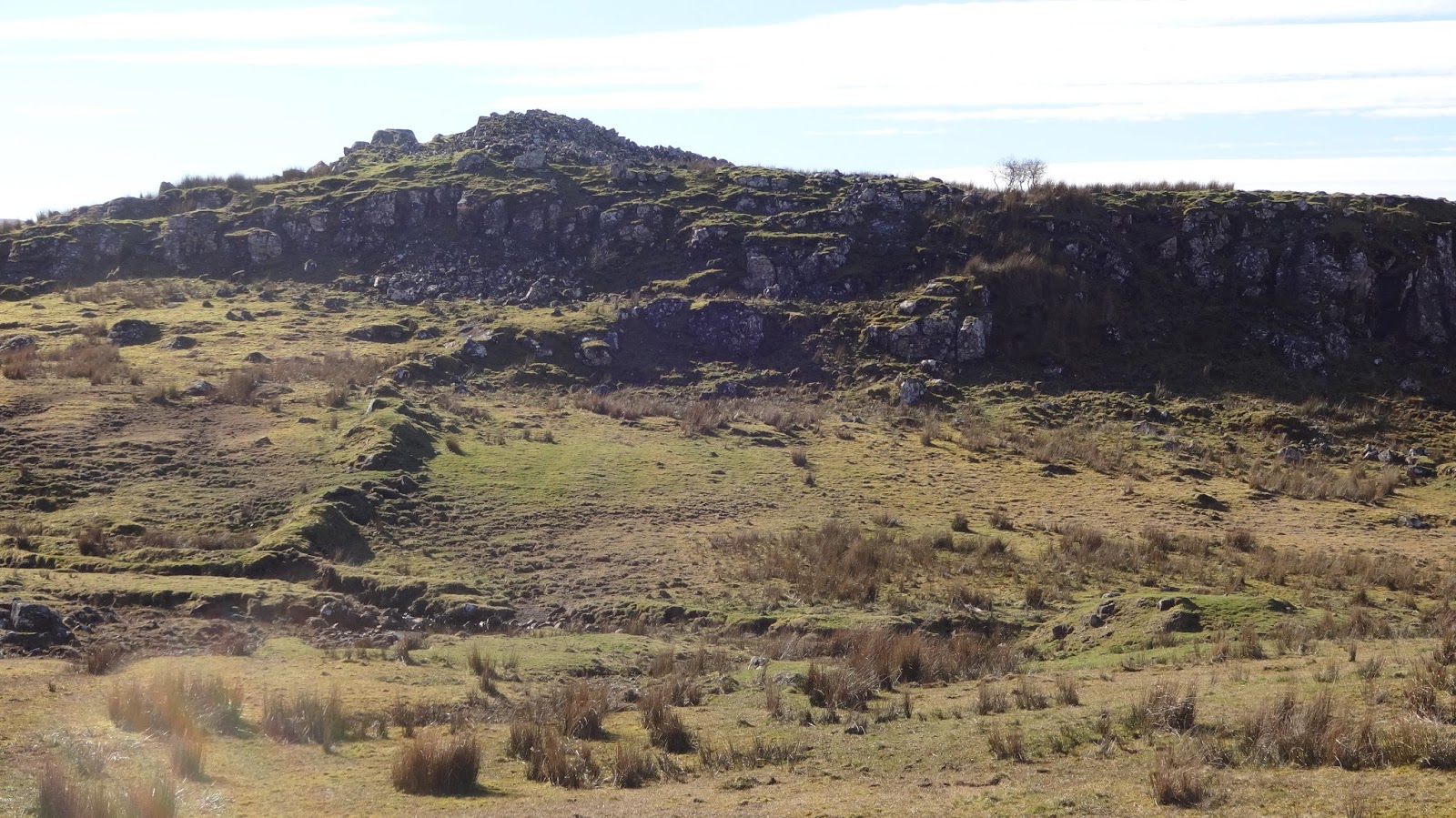
Described by RCHMS as an Iron Age fort,
is situated on a flat-topped ridge near the River Chracaig, No record of excavation has been found so
dating can only be approximate. I would
guess it is older than most of the Skye brochs and is probably early Iron Age,
maybe 500-600BC.
The most unusual feature, best seen from the Canmore aerial
photograph of 1989, are the three lines of massive boulders (Donaldson-Blythe claims
four[1])
to the south.

These were perhaps
intended to be an obstacle to potential invaders and are compared by Donaldson
Blythe to “Chevaux de Frise” seen in later structures. The wall behind these boulders is massive
while what remains of the walls to the North, West and East are rather less
substantial.
The entrance to the dun is described as being near the
middle of the E flank, with the foundations of a gateway 8ft 6ins wide.

Entry from the south, through the outer boulders would have been far easier but there is no evidence of a gateway there.
Just inside the south wall to the west, there is a clear outline which Canmore describes as an enclosure 28ft in length and 13ft in breadth.
Canmore also mentions a small oval structure 10ft long by 7ft broad on the inside of the second wall near its East end – we did not see evidence of this.


Although the cows we passed on our way to the Dun certainly belonged to a human crofter; it seems that in the past the fairies once inhabited or used this Dun to call in and count their cows.
In Skye, Fairy cattle are said to be speckled and red (crodh breac ruadh), and to be able to
cross the sea.
It is not on every place that they graze. There were not above ten such spots in all Skye. The field of Annat (achadh na h-annaid), in the Braes of Portree, is one. When the cattle came home at night from pasture, the following were the words used by the Fairy woman, standing on Dun Gerra-sheddar (Dun Ghearra-seadar), near Portree, as she counted her charge:
"Crooked one, dun one,
Little wing grizzled,
Black cow, white cow,
Little bull black-head,
My milch kine have come home,
O dear! that the herdsman would come!"[2]
Dun Gerashader offers amazing views all around.


There should be a clear line of sight to both Dun Borve and Dun Torvaig but neither are easy to pick out.

 From Gerashader we made our way to Dun Torvaig - which should be visible but is not easy to make out - I think it may be the lump to the right of the picture.
It is not on every place that they graze. There were not above ten such spots in all Skye. The field of Annat (achadh na h-annaid), in the Braes of Portree, is one. When the cattle came home at night from pasture, the following were the words used by the Fairy woman, standing on Dun Gerra-sheddar (Dun Ghearra-seadar), near Portree, as she counted her charge:
"Crooked one, dun one,
Little wing grizzled,
Black cow, white cow,
Little bull black-head,
My milch kine have come home,
O dear! that the herdsman would come!"[2]
Dun Gerashader offers amazing views all around.


There should be a clear line of sight to both Dun Borve and Dun Torvaig but neither are easy to pick out.


[1] Donaldson-Blyth,
Ian, (1995) In search of Prehistoric
Skye, Thistle Press 1995
[2] J G
Campbell (1900)., Superstitions of the Highlands and Islands of
Scotland, https://archive.org/stream/cu31924029909896/cu31924029909896_djvu.txt. Accessed 29/11/16
