Search This Blog

Showing posts with label Skye myths and legends. Show all posts

Tuesday, 29 November 2016

Dun Torvaig


Dun Torvaig (NG 4937 4422)  Visted 29/11/16

Directions: This Dun could be accessed from the Scorrybreac circuit but we walked along the Torvaig road from Dun Gerashader.  At the end of the Torvaig road a path (sign posted) goes off to the left and a rough track continues straight on.  Take the rough track.  A short way along a footpath sign can be seen near a kissing gate.  Go through this gate and through the next two (all very close together).  Having passed through the third gate, leave the footpath and follow a faint path along the fence line around the rocky knoll and up the next rocky knoll where the stones of Dun Torvaig can be seen.

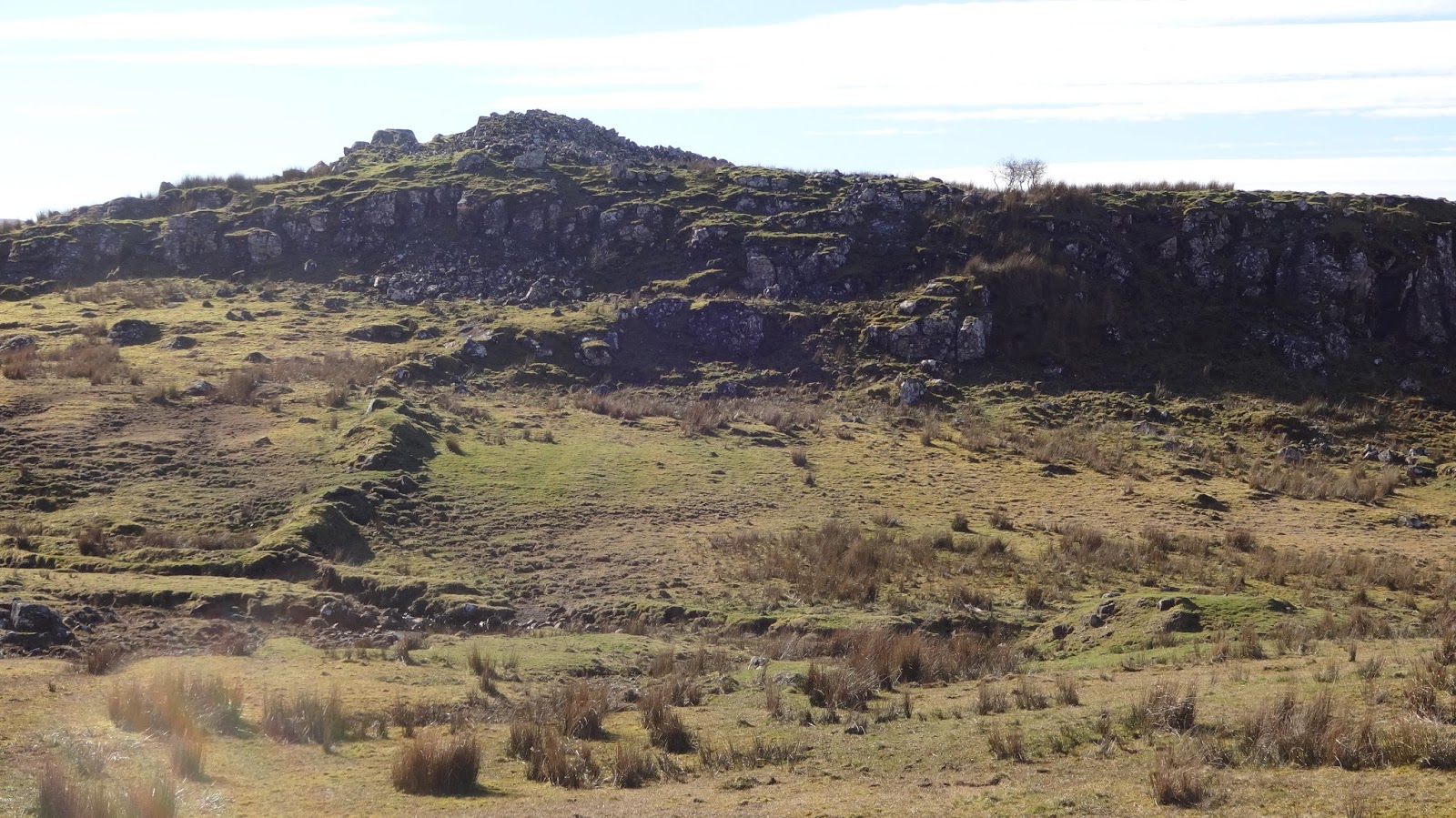
Like Gerashader, Dun Torvaig offers some stunning views: over the sound of Raasay, Portree Bay and back to Gerashader itself.  Dun Gerashader is visible in the distance.


 Like Dun Gerashader – it is a lovely site but not very photogenic in terms of its structure as there is little left to see. 


Dun Torvaig is believed to be early iron age although some believed it to have been “Scandinavian” 


Image from : http://www.scotlandsplaces.gov.uk/digital-volumes/ordnance-survey-name-books/inverness-shire-os-name-books-1876-1878/inverness-shire-skye-volume-08/42#zoom=2&lat=1157&lon=1612&layers=B the OS book of names   


Both Torvaig and Gerashader are similar to promontory forts except that in both cases they are constructed on inland ridges rather than peninsular promontories.


The two circular structures shown on the plan are both visible.  Canmore suggests that one is a more recent structure and the other could be simply fortuitous tumble.

Immediately to the north of the outworks is a level ledge “about 7m in diameter, which although probably natural, would make an excellent hut stance.”[1]


Myths and Legends: This area was definitely popular with the fairies[2]
A relative of Donald Murchison, who was employed as a herd boy on the farm of Scorybreck, fell asleep on a hill known as Dun Torvaig. Awaking from a heavy sleep, he found himself surrounded by fairies, and was a delighted spectator of their feasting and dancing. Meanwhile, in his home, he was mourned for as dead, and sad funeral feasts and loud wailing (and the latter is most heartrending) filled the house. What was the astonishment of the mourners when he arrived home, safe and well. Three weeks had elapsed, but he refused to believe it, and said, "It was the fine long sleep I had, but who would be sleeping the three weeks? It was but half a day I was after sleeping." He was safe and well certainly but never again the same lad, for he was ever distraught in manner, and ever sighing for the joys of the fairy-haunted Dun.


[2]   MacCulloch , Mary Julia (Jun. 30, 1922), Folk-Lore of the Isle of Skye, Folklore, Vol. 33, No. 2. Quoted at http://www.themodernantiquarian.com/site/9649/dun_torvaig.html 30/11/16 accessed 30/11/16

Dun Gerashader


Dun Gerashader.  (NG 4892 4527) Visited 29th November 2016


People driving from Portree to Staffin will pass Dun Gerashader without a second thought – just another pile of stones.  Easily accessed - drive approximately one mile from Portree on the Staffin road, park at the large layby on the right immediately before the Torvaig Road.  Enter the field via the gate just along the Torvaig road.  (Please enusre you close the gate carefully as there are cows grazing here; placidly grazing, these did not appear to be the fairy cows mentioned later) ) The short route to the Dun is boggy, trampled by cows and waterproof footwear is needed as there are a few narrow burns to cross. 

The Dun area is best accessed from the South (head left as you enter the field).


Described by RCHMS as an Iron Age fort, is situated on a flat-topped ridge near the River Chracaig,  No record of excavation has been found so dating can only be approximate.  I would guess it is older than most of the Skye brochs and is probably early Iron Age, maybe 500-600BC.


The most unusual feature, best seen from the Canmore aerial photograph of 1989, are the three lines of massive boulders (Donaldson-Blythe claims four[1]) to the south.  


These were perhaps intended to be an obstacle to potential invaders and are compared by Donaldson Blythe to “Chevaux de Frise” seen in later structures.  The wall behind these boulders is massive while what remains of the walls to the North, West and East are rather less substantial.


The entrance to the dun is described as being near the middle of the E flank, with the foundations of a gateway 8ft 6ins wide.
 

This is still visible but it is more difficult to imagine how the access to this gateway would have been reached.  The ridge is very rocky at this point.  From below it is possible to visualise a grassy ramp zig zagging up the ridge but the rocks immediately below the gateway are massive.   


Entry from the south, through the outer boulders would have been far easier but there is no evidence of a gateway there.

Just inside the south wall to the west, there is a clear outline which Canmore describes as an enclosure 28ft in length and 13ft in breadth. 

Canmore also mentions a small oval structure 10ft long by 7ft broad on the inside of the second wall near its East end – we did not see evidence of this.


Although the cows we passed on our way to the Dun certainly belonged to a human crofter; it seems that in the past the fairies once inhabited or used this Dun to call in and count their cows.

In Skye, Fairy cattle are said to be speckled and red (crodh breac ruadh), and to be able to cross the sea.

It is not on every place that they graze. There were not above ten such spots in all Skye. The field of Annat (achadh na h-annaid), in the Braes of Portree, is one. When the cattle came home at night from pasture, the following were the words used by the Fairy woman, standing on Dun Gerra-sheddar (Dun Ghearra-seadar), near Portree, as she counted her charge:

"Crooked one, dun one,
Little wing grizzled,
Black cow, white cow,
Little bull black-head,
My milch kine have come home,
O dear! that the herdsman would come!"[2] 


Dun Gerashader offers amazing views all around. 


There should be a clear line of sight to both Dun Borve and Dun Torvaig but neither are easy to pick out.  


From Gerashader we made our way to Dun Torvaig - which should be visible but is not easy to make out - I think it may be the lump to the right of the picture.


[1] Donaldson-Blyth, Ian,  (1995) In search of Prehistoric Skye, Thistle Press 1995

[2] J G Campbell (1900)., Superstitions of the Highlands and Islands of Scotland, https://archive.org/stream/cu31924029909896/cu31924029909896_djvu.txt.  Accessed 29/11/16